Thursday, December 11, 2008

Visual long-term memory has a massive storage

Visual long-term memory has a massive storage
capacity for object details
Timothy F. Brady*, Talia Konkle, George A. Alvarez, and Aude Oliva*
Department of Brain and Cognitive Sciences, Massachusetts Institute of Technology, Cambridge, MA 02139
Edited by Dale Purves, Duke University Medical Center, Durham, NC, and approved August 1, 2008 (received for review April 8, 2008)

One of the major lessons of memory research has been that human
memory is fallible, imprecise, and subject to interference. Thus,
although observers can remember thousands of images, it is
widely assumed that these memories lack detail. Contrary to this
assumption, here we show that long-term memory is capable of
storing a massive number of objects with details from the image.


© 2008 by The National Academy of Sciences of the USA


Image Courtesy

Tuesday, August 12, 2008

Robots learn to move themselves

Researchers in Leipzig have demonstrated software designed for robots that allows them to "learn" to move through trial and error.


SOURCE: BBC NEWS

Thursday, July 10, 2008

Status, free will, the human condition.


Wolfe, who calls himself "the social secretary of neuroscience," often turns to current research to inform his stories and cultural commentary. His 1996 essay, "Sorry, But Your Soul Just Died," raised questions about personal responsibility in the age of genetic predeterminism. Similar concerns led Gazzaniga to found the Law and Neuroscience Project. When Gazzaniga, who just published Human: The Science Behind What Makes Us Unique, was last in New York, Seed incited a discussion: on status, free will, and the human condition.


Source: SeedMagazine.com
Article by: EDIT STAFF

IMAGE COURTESY :'Free Will,' by Joseph M. Thompson (2004)

Monday, April 07, 2008

Island of stability


-This is quite a breakthrough for science,- Said Chemistry, Materials and Life Sciences Associate Director Tomas Diaz de la Rubia. -We’ve discovered a new element that provides insight into the makeup of the universe. For our scientists to find another piece of the puzzle is a testament to the strength and value of the science and technology at this Laboratory.-


“Now that it has been shown that the ‘island of stability’ of superheavy elements exists, it would be interesting to predict the position of other islands,” said Yuri Oganessian, Ph.D., of Russia’s Joint Institute for Nuclear Research in Dubna. He is the scientific leader at the Institute’s Flerov Laboratory of Nuclear Reactions.


PHOTO COURTESY:
-LISE MEITNER PRIZE FOR NUCLEAR SCIENCE.-
-www.llnl.gov/str/Diaz.html-

IMAGE CREDITS: Ernest Orlando Lawrence Berkeley National Laboratory.-

Wednesday, March 05, 2008


THIS SITE WILL BE UPDATED ON APRIL 2008


Please,
Defend Human Rigths, support the Dalai Lama .

Friday, January 18, 2008

Atomic-level dance


After three years of study, researchers at Texas Tech University and the Physics Institute of the University of Freiburg, Germany,

have found that one type of a certain chemical reaction fundamental to cellular biochemistry is actually more complex than originally thought.

ScienceDaily (Jan. 18, 2008)


Dance around the Maypole


Thursday, January 17, 2008

Future directions in computing


On BBC NEWS-Technology:- Six advances that could spell the end of traditional computing .-


The Center for Quantum Computation's Web site:
http://www.qubit.com/


Articles related to quantum information science:

Thursday, April 12, 2007

Black Holes


Photo Courtesy Chandra Harvard.
Chandra Sees Remarkable Eclipse of Black Hole
This was revealed during a series of observations of NGC 1365

Electrons!


An international team of researchers working with Ferenc Krausz has now caught the electrons in the act of tunnelling through the binding potential of the atom nucleus under the influence of laser light. The physicists used the new tools provided by attosecond metrology. "For the first time, our findings confirmed in real time observation the theoretical predictions of quantum mechanics," says Ferenc Krausz, Director at the Max Planck Institute for Quantum Optics and head of the team of scientists. ( article's in Science Daily)

Friday, February 16, 2007

A quantum brain? Quantum consciousness?


The most difficult problem… concerning the use of the language arises in quantum theory. Here we have at first no simple guide for correlating the mathematical symbols with concepts of ordinary language: and the only thing we know from the start is the fact that our common concepts cannot be applied o the structure of the atoms. (Heisenberg, Physics and Philosophy, 1963)

"Our brains follow the same basic laws of the whole universe. These laws are quantum mechanical. In our brain dance electrons and photons - the particles of light responsible for communication between electrons. The dance of electrons with light makes up our minds and provides the stability of our 85-percent water-filled brains. Thus it is that mind will not be found in any physical pattern of our brain material, but instead in quantum wave functions" (WOLF 1984, p. 134).


"quantum mechanics is the mechanics of the human spirit" (WOLF 1984, p.267/268).

Thursday, February 15, 2007

Neuroethics


Neuroethics n. The moral principles and standards governing the scanning, treatment, and enhancement of the brain


... Even in their current state, brain scans may be able to reveal, without our consent, hidden things about who we are and what we think and feel. ... Before such scans are used, neuroethicists warn, we must understand what they can and cannot do.
—Francine Russo, "Who Should Read Your Mind?," Time, January 29, 2007

Plastic challenge to silicon microchip


Plastic challenge to silicon microchip
By Peter Marsh in London


The plastic semiconductors are made using a process similar to ink-jet printing, which is widespread in the packaging industry for producing labels.

Wednesday, February 14, 2007

Building Brains in Silicon


SCIENTIST'S TEAM AT STANFORD UNIVERSITY :- We have two synergistic goals: We wish to understand how brains work; this will enable us to replace damaged neural tissue. And we want to build computers that work like brains; this will enable us to increase computational power a million fold.-

Friday, February 09, 2007

Superstrings(?)


A proposed orbiting observatory called the Laser Interferometer Space Antenna, being developed by the National Aeronautics and Space Administration, could provide the first measurements of very low frequency gravitational waves, perhaps the first such measurements at any frequency, cosmologist Craig Hogan said. In addition to the expected wave sources, such as binary stars and black holes, these signals also might include the first direct evidence of cosmic superstrings.

Monday, November 27, 2006

Evidence That Subliminal Is Not So 'Sub'


In an article in the November 9, 2006, issue of the journal Neuron, published by Cell Press, Kimihiro Nakamura and colleagues report experiments with human volunteers demonstrating such "top-down" processing of subliminal information.

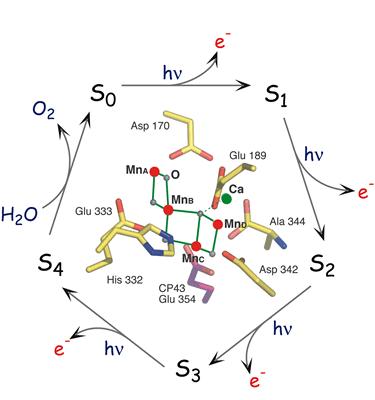
Learning How Nature Splits Water


High-resolution structure of photosynthetic catalyst holds promise for clean energy


Photo Courtesy: U.S. Department of Energy’s Lawrence Berkeley National Laboratory (Berkeley Lab)

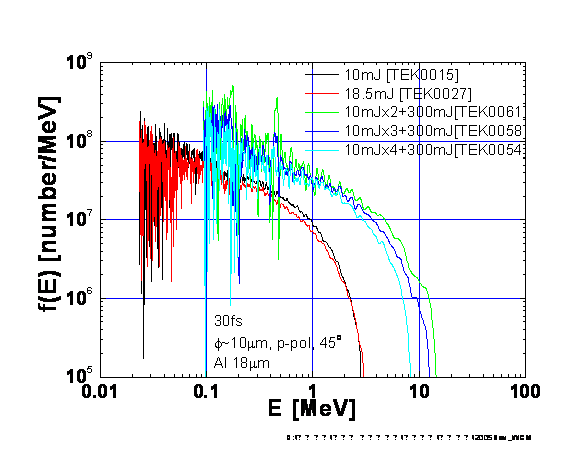
Ultra-Intense Laser Blast Creates True 'Black Metal'


Guo's research team has tested the absorption capabilities for the black metal and confirmed that it can absorb virtually all the light that fall on it, making it pitch black.

Neuroscience and meditation!


Buddha drew a clear distinction between our body and our mind. Although the two are related, he said, they are not the same thing. The mind is not the brain, and the brain is not the mind.